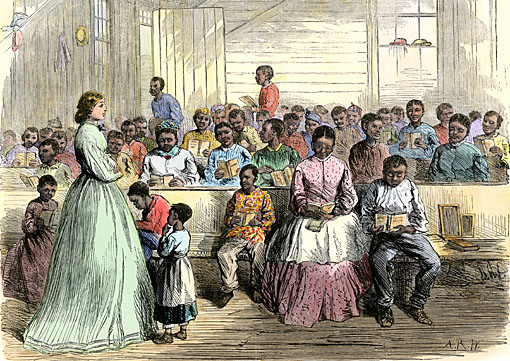
Education in the United States has humble beginnings. Simple and straightforward was the name of the game: teach them to read using the Bible or patriotic essays, but labor was still emphasized until the turn of the century. It wasn’t until Educators, like Horace Mann advocated for children’s needs in the classroom, comparing the teaching techniques to “barbaric and grim.” He brought about a push for literature to be retold in child friendly abridged versions, like, Alice in Wonderland, Gulliver’s Travels, and Black Beauty (1905). With the emergence of labor unions and two World Wards, educational research seemingly halted for a period of time in the early to mid nineteenth century (K12 Academics, 2020).
A meaning-based curriculum did not emerge until after the Nation’s major World Wars had concluded in the 1950’s. Educational researchers and authors like Rudolf Flesch wrote books like Why Johnny Can’t Read, a passionate argument in favor of teaching children to read using phonics. Until then, we were still teaching children to read using “whole language” very similar to sight word reading solely. Despite the popularity and support from the general public, phonics still remained debated amongst the educational community (K12 Academics, 2020).
The polarization continues even today about the debate of what teaching techniques to use. One could argue that the emergence of different reading techniques around the 1950’s brought about a need for a specialization in reading, or a literacy coach, to help reach our children through the use of different reading strategies. Some even might say the push of “No Child Left Behind” began the explosion of assisting children in whatever means necessary to be successful in school. No matter what time period, recent or in the last hundred years, Literacy Specialists have earned their place as essential for schools to meet struggling learners’ needs.
“Research motivates early childhood education and other disciplines (e.g. child development, psychology, educational psychology, other related fields) to continue changing. These disciplines need to sustain their scientific reliability in the constant challenges of the modern time. It is essential that these disciplines examine, improve, and refine theories related to research in young children’s language and literacy development.”
(Saracho, 2017, p. 299)
…thus we have the purpose of a literacy specialist:
an educator who provides up to date expert instruction,
assessment, and leadership for a reading program.
What does literacy look like today ?

Theory of Reading Development
Summary and Rationale
Chall’s (1996) reading development stages ( 0: pre-reading-1: initial reading decoding-2: conformation and fluency-3a&b: reading to learn the new-4:to analyze and critically assess the different viewpoints-5:construction and reconstruction, the most mature level) is a reference point for developmental purposes in the classroom environment. A literacy coach or even general education teacher in a fourth-grade classroom could use this as a springboard for pinpointing failure points in reading ability. For example, we group our students homogeneously for intervention instruction: the different levels in Chall’s (1996) developmental stages can help group these students by what stages they are currently in, versus where they should be in fourth grade.

Theory of Writing Development
Summary & Rationale
Schickedanz & Collins (2013) emphasize that their theory is intended to help teachers and parents understand literacy development in its earliest stages, and how to support it–starting from infancy through subsequent years. Their unconventional theory serves to be a deeper perspective for making room for literacy development to be organic, playful, interesting, and a joyous place whether at home or school. Parents and teachers can apply the knowledge of this theory by accessing plenty of leveled literature, tools for writing in all it’s basic forms, and creating a safe environment where exploration and discovery are emphasized (Schickedanz & Collins, 2013). These components also translate to a fourth-grade classroom. Access to various levels and themes of print can be created in a fourth grade classroom; as well as, allotted time to freely and creatively write with no boundaries, emphasizing that an educator’s role is to enhance the environment, answer children’s questions, and to respond with interest and enthusiasm to their writing creations (Schickedanz & Collins, 2013).

Writing process
Summary & Implementation in Fourth grade
Developmentally in fourth grade, students should be in the last stage of the following:
- Pre-Literate: Scribble & Symbolic stage
- Emergent: Letter formation & Environmental print stage
- Transitional: Words with medial sounds and sentences stage
- Fluent: Phrase writing and the six traits of writing stage
Therefore, writing in fourth grade may look like: teaching multiple strategies (spelling, grammar, sentence structure) through reading experiences: Write about what would happen next in a story; help children rewrite the story in a different setting and change the characters—making sure to model appropriate writing (Morrow, 2005).
More fluent writers are encouraged to experiment and practice their writing skills with multiple writing forms: brochures, biographies, diaries & journal entries, lab reports, stories, recipes, song lyrics, & more. As they practice with these writing forms students can focus using the R.A.F.T. structure to help convert it to an authentic assignment: role, audience, form, topic (Moore & Cunningham, 2010).
Components of Language
Summary & Integration
Rising fourth graders developmentally should display language skills that include:
*listening for a sustained period of time
*Uses appropriate grammar in their speech and written work
*Can problem solve & ask questions to clarify key concepts
Specifically, the five components are also integrated as follows:
*Phonemic Awareness & Phonics: students continue to use these skills fluently to sound out unfamiliar words to chunk them into familiar parts to decipher their meaning (Altinkaynak, 2019).
*Vocabulary & Comprehension: The usage and identification of words as well as comprehension builds over time through exposure (through reading, speaking, listening, writing, and story telling skills) and keeps building exponentially at this level (Kid Sense , 2020).
*Fluency: The growth of being able to “read like you speak.” It is composed of three key elements: accuracy, prosody (patterns of rhythm and sound), and expression. Support in fluency at the fourth grade level means actively engaging in modeling proper phrasing and pace while reading with a child; as well as, repeated readings: can be done with a teacher, peer, parent, or recording -more exposure to words=better familiarity=more expression (Guasti, 2004).
References
Altinkaynak, S. (2019). The effect of interactive book reading activities on children’s print and phonemic awareness skills. International Journal of Progressive Education, 15(1), 88–99.
Chall, J. S. (1996). Stages of reading development (2nd ed.). Fort Worth: Harcourt Brace Jovanovic College Publishers.
Finestack, L. H., & Satterlund, K. E. (2018). Current practice of child grammar intervention: a survey of speech-language
pathologists. American Journal of Speech-Language Pathology, 27(4), 1329–1351. https://doi org.lopes.idm.oclc.org/10.1044/2018_AJSLP- 17-0168
Guasti, M.T. (2004). Language acquisition: the growth of grammar (0-262-07222-X, 978-0-262-07222-9).
Kid Sense (2020). Stages of language development chart. Retrieved from https://childdevelopment.com.au/resources/child-development-charts/stages-of- language-development-chart/
K12 Academics. (2020, August 8). History of reading education in the U.S. retrieved from http://www.k12academics.com/reading-education-united-states/history-reading-education-us.
Moore, D.W., Moore, S.A., Cunningham, P.M., Cunningham, J.W. (2010). Developing readers and writers in the content areas (6th ed). Boston, MA: Pearson. ISBN-13: 9780137056378
Morrow, L.M. (2005). Literacy development in the early years (5th ed.). Boston, MA: Pearson. ISBN-10: 0205392563
Saracho, O. (2017) Literacy and language: new developments in research, theory, and practice, early child development and care, 187:3-4, 299 304, DOI: 10.1080/03004430.2017.1282235
Schickedanz, J.A. & Collins, M.F. (2013) So Much More Than the ABCs: The Early Phases of Reading and Writing: NAEYC (Series). National Association for the Education of Young Children.

